HyCARD-Net: A Synergistic Hybrid Intelligence Framework for Cardiovascular Disease Diagnosis
CNN-LSTM, k-nearest neighbours and XGBoost under a weighted majority vote
1American International University-Bangladesh 2Chengdu Industry and Trade College 3Shinawatra University 4Tilburg University
†Corresponding author
Abstract
Cardiovascular disease (CVD) remains the foremost cause of mortality worldwide, underscoring the urgent need for intelligent and data-driven diagnostic tools. Traditional predictive models often struggle to generalize across heterogeneous datasets and complex physiological patterns. To address this, we propose a hybrid ensemble framework that integrates deep learning architectures, Convolutional Neural Networks (CNN) and Long Short-Term Memory (LSTM), with classical machine learning algorithms, including K-Nearest Neighbor (KNN) and Extreme Gradient Boosting (XGB), using an ensemble voting mechanism. This approach combines the representational power of deep networks with the interpretability and efficiency of traditional models. Experiments on two publicly available Kaggle datasets demonstrate that the proposed model achieves superior performance, reaching 82.30% accuracy on Dataset I and 97.10% on Dataset II, with consistent gains in precision, recall, and F1-score.
Results reported in the paper
Dataset I (Table II)
| Group | Model | Accuracy | Recall | F1 | Precision |
|---|---|---|---|---|---|
| Machine learning | NB | 75.50 (0.13) | 75.90 (0.08) | 76.00 (0.17) | 75.80 (0.11) |
| Machine learning | LR | 76.80 (0.08) | 77.80 (0.28) | 77.40 (0.21) | 77.20 (0.15) |
| Machine learning | SVM | 77.50 (0.29) | 77.90 (0.15) | 77.70 (0.19) | 77.80 (0.08) |
| Machine learning | RF | 77.80 (0.11) | 78.10 (0.19) | 78.20 (0.23) | 78.30 (0.25) |
| Machine learning | MLP | 76.80 (0.14) | 77.90 (0.11) | 77.80 (0.09) | 77.60 (0.23) |
| Machine learning | KNN | 78.30 (0.16) | 79.10 (0.17) | 79.20 (0.16) | 79.40 (0.12) |
| Machine learning | DT | 77.30 (0.28) | 78.20 (0.12) | 78.30 (0.14) | 78.40 (0.05) |
| Ensemble-based | XGB | 78.90 (0.31) | 79.30 (0.23) | 79.20 (0.14) | 79.40 (0.22) |
| Ensemble-based | LGBM | 78.10 (0.17) | 78.90 (0.28) | 78.60 (0.21) | 78.70 (0.17) |
| Ensemble-based | AdaBoost | 77.90 (0.23) | 78.80 (0.23) | 78.70 (0.19) | 78.90 (0.26) |
| Combinational ML | RF + DT + NB + LR | 79.50 (0.19) | 79.70 (0.23) | 79.40 (0.09) | 79.50 (0.20) |
| Combinational ML | RF + DT + KNN + NB + SVM + LGBM + XGB + MLP + LR | 79.00 (0.28) | 79.20 (0.20) | 79.00 (0.08) | 79.10 (0.11) |
| Deep learning | CNN | 78.80 (0.32) | 80.00 (0.15) | 79.80 (0.13) | 80.10 (0.14) |
| Deep learning | LSTM | 78.00 (0.19) | 80.10 (0.27) | 79.90 (0.17) | 80.00 (0.27) |
| Combinational DL | CNN-LSTM | 80.00 (0.21) | 81.80 (0.14) | 81.40 (0.08) | 81.30 (0.14) |
| Proposed model | CNN-LSTM + KNN + XGB | 82.30 (0.23) | 84.00 (0.09) | 83.50 (0.18) | 83.60 (0.11) |
Dataset II (Table III)
| Group | Model | Accuracy | Recall | F1 | Precision |
|---|---|---|---|---|---|
| Machine learning | NB | 90.50 (0.11) | 90.20 (0.14) | 91.00 (0.28) | 91.40 (0.21) |
| Machine learning | LR | 91.70 (0.28) | 91.80 (0.13) | 91.60 (0.21) | 92.10 (0.17) |
| Machine learning | SVM | 90.80 (0.19) | 91.50 (0.18) | 91.40 (0.24) | 91.70 (0.13) |
| Machine learning | RF | 91.90 (0.16) | 92.10 (0.24) | 92.30 (0.15) | 92.40 (0.15) |
| Machine learning | MLP | 93.50 (0.14) | 93.60 (0.15) | 93.40 (0.19) | 93.70 (0.22) |
| Machine learning | KNN | 94.35 (0.13) | 94.50 (0.05) | 94.80 (0.19) | 94.60 (0.14) |
| Machine learning | DT | 91.75 (0.08) | 92.60 (0.21) | 92.40 (0.21) | 92.70 (0.28) |
| Ensemble-based | XGB | 94.10 (0.09) | 94.00 (0.15) | 93.80 (0.12) | 94.00 (0.08) |
| Ensemble-based | LGBM | 92.80 (0.21) | 93.70 (0.18) | 93.50 (0.31) | 93.20 (0.23) |
| Ensemble-based | AdaBoost | 91.50 (0.20) | 92.70 (0.28) | 92.40 (0.19) | 92.80 (0.24) |
| Combinational ML | RF + DT + NB + LR | 94.50 (0.31) | 92.10 (0.08) | 93.10 (0.23) | 92.90 (0.19) |
| Combinational ML | RF + DT + KNN + NB + SVM + LGBM + XGB + MLP + LR | 94.30 (0.05) | 93.50 (0.21) | 93.20 (0.48) | 93.40 (0.14) |
| Deep learning | CNN | 93.80 (0.19) | 93.60 (0.13) | 93.70 (0.13) | 93.50 (0.09) |
| Deep learning | LSTM | 91.50 (0.16) | 92.60 (0.14) | 92.80 (0.15) | 92.70 (0.21) |
| Combinational DL | CNN-LSTM | 94.45 (0.15) | 94.70 (0.13) | 94.90 (0.11) | 94.70 (0.12) |
| Proposed model | CNN-LSTM + KNN + XGB | 97.10 (0.17) | 95.50 (0.28) | 95.20 (0.08) | 96.80 (0.14) |
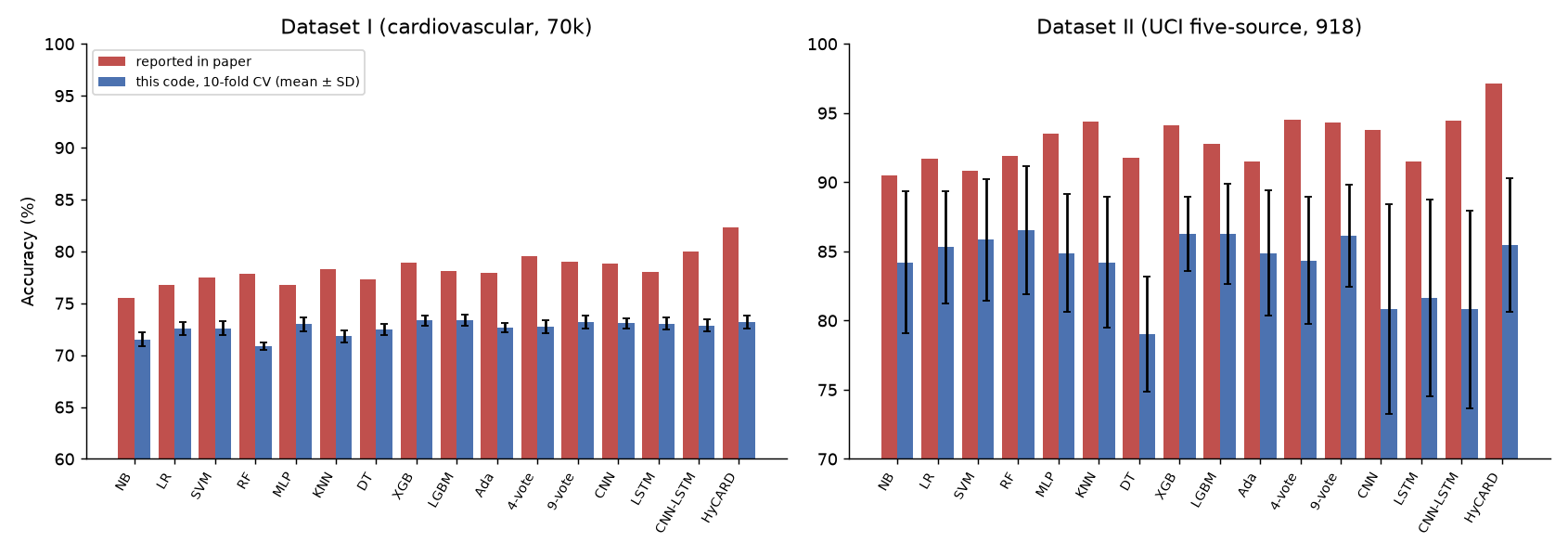
Mean (standard deviation) over 10-fold cross-validation, as printed in the paper. Ablation: hybrid 82.3% vs CNN-LSTM 81.0% on Dataset I and 97.1% vs 94.5% on Dataset II.
Reimplementation results
- Dataset I: the paper reports 82.30% ± 0.23 for the ensemble; this code measures 73.20% ± 0.60 in 10-fold cross-validation and 73.66% on the held-out 20%. The best single model here is LGBM at 73.36%.
- Dataset II: the paper reports 97.10% ± 0.17 for the ensemble; this code measures 85.44% ± 4.83 in 10-fold cross-validation and 86.41% on the held-out 20%. The best single model here is RF at 86.53%.
Dataset I
| Model | Paper | This code, 10-fold CV | This code, held-out |
|---|---|---|---|
| NB | 75.50 | 71.52 ± 0.68 | 72.28 |
| LR | 76.80 | 72.58 ± 0.64 | 73.31 |
| SVM | 77.50 | 72.61 ± 0.67 | 73.38 |
| RF | 77.80 | 70.87 ± 0.36 | 70.75 |
| MLP | 76.80 | 72.99 ± 0.67 | 73.71 |
| KNN | 78.30 | 71.85 ± 0.58 | 72.34 |
| DT | 77.30 | 72.50 ± 0.52 | 73.16 |
| XGB | 78.90 | 73.33 ± 0.52 | 73.79 |
| LGBM | 78.10 | 73.36 ± 0.50 | 73.63 |
| AdaBoost | 77.90 | 72.66 ± 0.46 | 73.46 |
| RF+DT+NB+LR | 79.50 | 72.75 ± 0.65 | 73.57 |
| RF+DT+KNN+NB+SVM+LGBM+XGB+MLP+LR | 79.00 | 73.18 ± 0.59 | 73.73 |
| CNN | 78.80 | 73.06 ± 0.49 | 73.46 |
| LSTM | 78.00 | 73.05 ± 0.57 | 72.64 |
| CNN-LSTM | 80.00 | 72.87 ± 0.56 | 73.43 |
| HyCARD-Net (CNN-LSTM+KNN+XGB) | 82.30 | 73.20 ± 0.60 | 73.66 |
Dataset II
| Model | Paper | This code, 10-fold CV | This code, held-out |
|---|---|---|---|
| NB | 90.50 | 84.22 ± 5.12 | 83.70 |
| LR | 91.70 | 85.30 ± 4.05 | 85.33 |
| SVM | 90.80 | 85.85 ± 4.40 | 87.50 |
| RF | 91.90 | 86.53 ± 4.64 | 86.41 |
| MLP | 93.50 | 84.89 ± 4.23 | 82.61 |
| KNN | 94.35 | 84.20 ± 4.72 | 83.70 |
| DT | 91.75 | 79.02 ± 4.13 | 80.98 |
| XGB | 94.10 | 86.24 ± 2.67 | 84.24 |
| LGBM | 92.80 | 86.25 ± 3.61 | 84.78 |
| AdaBoost | 91.50 | 84.88 ± 4.55 | 85.87 |
| RF+DT+NB+LR | 94.50 | 84.35 ± 4.57 | 84.78 |
| RF+DT+KNN+NB+SVM+LGBM+XGB+MLP+LR | 94.30 | 86.12 ± 3.67 | 84.78 |
| CNN | 93.80 | 80.82 ± 7.57 | 83.70 |
| LSTM | 91.50 | 81.62 ± 7.13 | 80.98 |
| CNN-LSTM | 94.45 | 80.82 ± 7.15 | 80.98 |
| HyCARD-Net (CNN-LSTM+KNN+XGB) | 97.10 | 85.44 ± 4.83 | 86.41 |
The paper does not specify layer sizes, hyperparameters, the outlier rule or the oversampling method; the choices made here are listed in the README.
Citation
@inproceedings{dasgupta2025hycard,
  title     = {{HyCARD-Net}: A Synergistic Hybrid Intelligence Framework for Cardiovascular Disease Diagnosis},
  author    = {Das Gupta, Rajan and Wu, Xiaobin and Liu, Xun and He, Jiaqi},
  booktitle = {2025 4th International Conference on Image Processing, Computer Vision and Machine Learning (ICICML)},
  publisher = {IEEE},
  year      = {2025},
  pages     = {1365--1370},
  doi       = {10.1109/ICICML67980.2025.11333523},
  url       = {https://arxiv.org/abs/2601.17767}
}