ViMoNet: A Multimodal Vision-Language Framework for Human Behavior Understanding from Motion and Video
Motion and video, fused in the language space, for behavior-centric reasoning
1American International University-Bangladesh 2Shinawatra University 3Multimedia University 4Washington University of Science & Technology
†Corresponding author
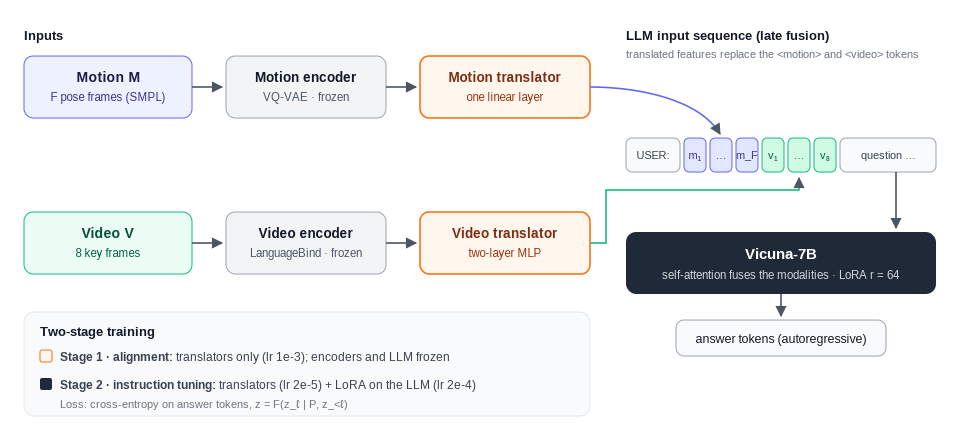
<motion> and <video> tokens of the prompt, so self-attention in the LLM fuses the modalities.Abstract
This study investigates the use of large language models (LLMs) for human behavior understanding by jointly leveraging motion and video data. We argue that integrating these complementary modalities is essential for capturing both fine-grained motion dynamics and contextual semantics of human actions, addressing the limitations of prior motion-only or video-only approaches. To this end, we propose ViMoNet, a multimodal vision-language framework trained through a two-stage alignment and instruction-tuning strategy that combines precise motion-text supervision with large-scale video-text data. We further introduce VIMOS, a multimodal dataset comprising human motion sequences, videos, and instruction-level annotations, along with ViMoNet-Bench, a standardized benchmark for evaluating behavior-centric reasoning. Experimental results demonstrate that ViMoNet consistently outperforms existing methods across caption generation, motion understanding, and human behavior interpretation tasks. The proposed framework shows significant potential in assistive healthcare applications, such as elderly monitoring, fall detection, and early identification of health risks in aging populations.
Method
Translators
A frozen VQ-VAE encodes the motion sequence and a frozen LanguageBind encoder encodes eight key frames. Motion is mapped into the LLM space by one linear layer, video by a two-layer MLP, since skeleton and video features differ in structure and richness.
Late fusion
The translated motion and video tokens are inserted where the prompt says <motion> and <video>. There are no cross-attention modules: the LLM's self-attention relates the modalities, and clip-level alignment with instruction tuning makes it robust to temporal misalignment.
Two-stage training
Stage 1 trains only the translators (lr 1e-3) on motion and video captioning data. Stage 2 keeps training the translators (lr 2e-5) and adapts Vicuna-7B with LoRA (rank 64, lr 2e-4) on joint motion, video and text instructions.
VIMOS and ViMoNet-Bench
ViMoNet-Bench evaluates five domains of behavior understanding: sequentiality, direction, body-part awareness, reasoning and hallucination. VIMOS is built on AMASS, HumanML3D and Motion-X, whose terms restrict redistribution; the data card describes the composition, the sources and how to obtain them.
Results
| Model | Accuracy (%) | Score (0-5) |
|---|---|---|
| FrozenBiLM | 24.7 | – |
| VideoChat | – | 2.2 |
| LLaMA-Adapter | 34.2 | 2.7 |
| Video-LLaMA | 12.4 | 1.1 |
| Video-ChatGPT | 35.2 | 2.7 |
| Video-LLaVA | 45.3 | 3.3 |
| Video-chat2 | 49.1 | 3.3 |
| ViMoNet (ours) | 53.5 | 3.53 |
Table II of the paper: zero-shot video QA on ActivityNet-QA, accuracy and GPT-judged score. Adding motion improves video understanding by 15.6%, and visual context improves motion reasoning by 30.1%.
Code
The repository holds a reference implementation of the architecture and training recipe, the evaluation protocols (multiple-choice accuracy and GPT-judged accuracy and score), and a synthetic data generator in the VIMOS format, so the whole pipeline runs on a laptop.
git clone https://github.com/rajandasguptaml/ViMoNet.git && cd ViMoNet
pip install -r requirements.txt
python -m vimonet.synthetic --out data/synthetic --n 600
python -m vimonet.train --config configs/demo_tiny.yaml --stage 1
python -m vimonet.train --config configs/demo_tiny.yaml --stage 2 --init outputs/demo_tiny/stage1
python -m vimonet.evaluate --checkpoint outputs/demo_tiny/stage2 --data data/synthetic/test.jsonl --judge exact
Responsible use
Behavior understanding can support elderly monitoring and fall detection, and it can also enable surveillance or fabricated behavior descriptions. The paper recommends watermarking generated outputs, auditing annotations and outputs for bias with humans in the loop, and controlled deployment through usage restrictions and licensing.
Citation
@inproceedings{dasgupta2025vimonet,
  title     = {{ViMoNet}: A Multimodal Vision-Language Framework for Human Behavior Understanding from Motion and Video},
  author    = {Das Gupta, Rajan and Wei, Lei and Rahat, Md Yeasin and Fahad, Nafiz and Ahmed, Abir and Liew, Tze Hui},
  booktitle = {2025 5th International Symposium on Artificial Intelligence and Big Data (AIBDF)},
  publisher = {IEEE},
  year      = {2025},
  pages     = {1025--1029},
  doi       = {10.1109/AIBDF67964.2025.11440858}
}